
Wave Particles
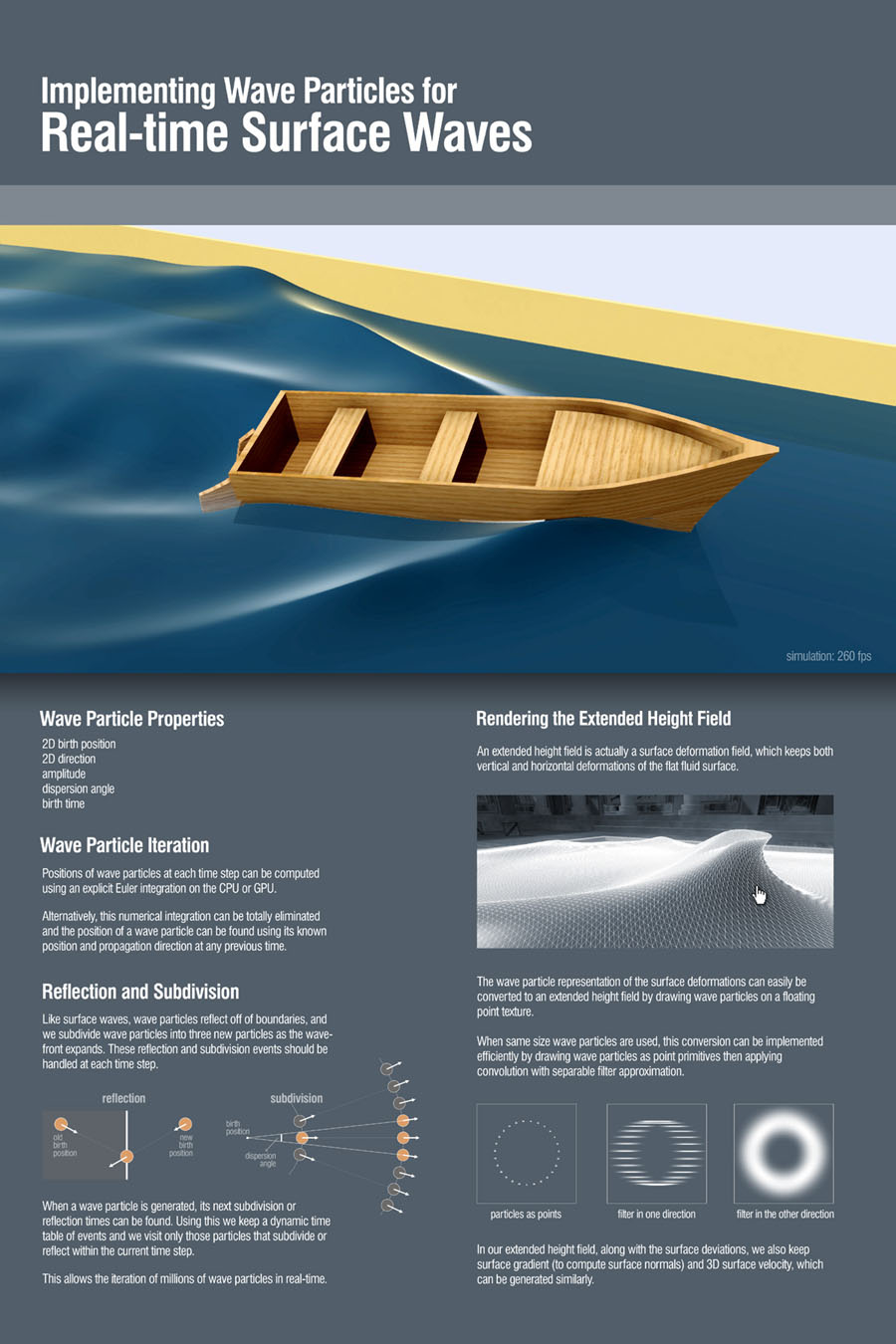
This is captured from our real-time simulation, showing three boats in the open ocean. The dynamic surface waves generated due to boat motion are simulated using wave particles. In addition, boat motion is not scripted or animated, it is also simulated. The forward motion of the boats is induced by the fluid-object interaction forces acting on the rotating propellers of the boats and the boats turn due to the fluid-object interaction forces on the their rudders.
Abstract
We present a new method for the real-time simulation of fluid surface waves and their interactions with floating objects. The method is based on the new concept of wave particles, which offers a simple, fast, and unconditionally stable approach to wave simulation. We show how graphics hardware can be used to convert wave particles to a height field surface, which is warped horizontally to account for local wave-induced flow. The method is appropriate for most fluid simulation situations that do not involve significant global flow. It is demonstrated to work well in constrained areas, including wave reflections off of boundaries, and in unconstrained areas, such as an ocean surface. Interactions with floating objects are easily integrated by including wave forces on the objects and wave generation due to object motion. Theoretical foundations and implementation details are provided, and experiments demonstrate that we achieve plausible realism. Timing studies show that the method is scalable to allow simulation of wave interaction with several hundreds of objects at real-time rates.
Video Clips
Wave particles generated by mouse click and drag.
Here is example from our real-time simulation, running at 170 fps on an NVIDIA GeForce 7900 GTX graphics card (released in 2006). The boat motion is induced by the fluid-object interaction forces acting on the rotating propeller, the boat body, and the joystick-controlled rudder.
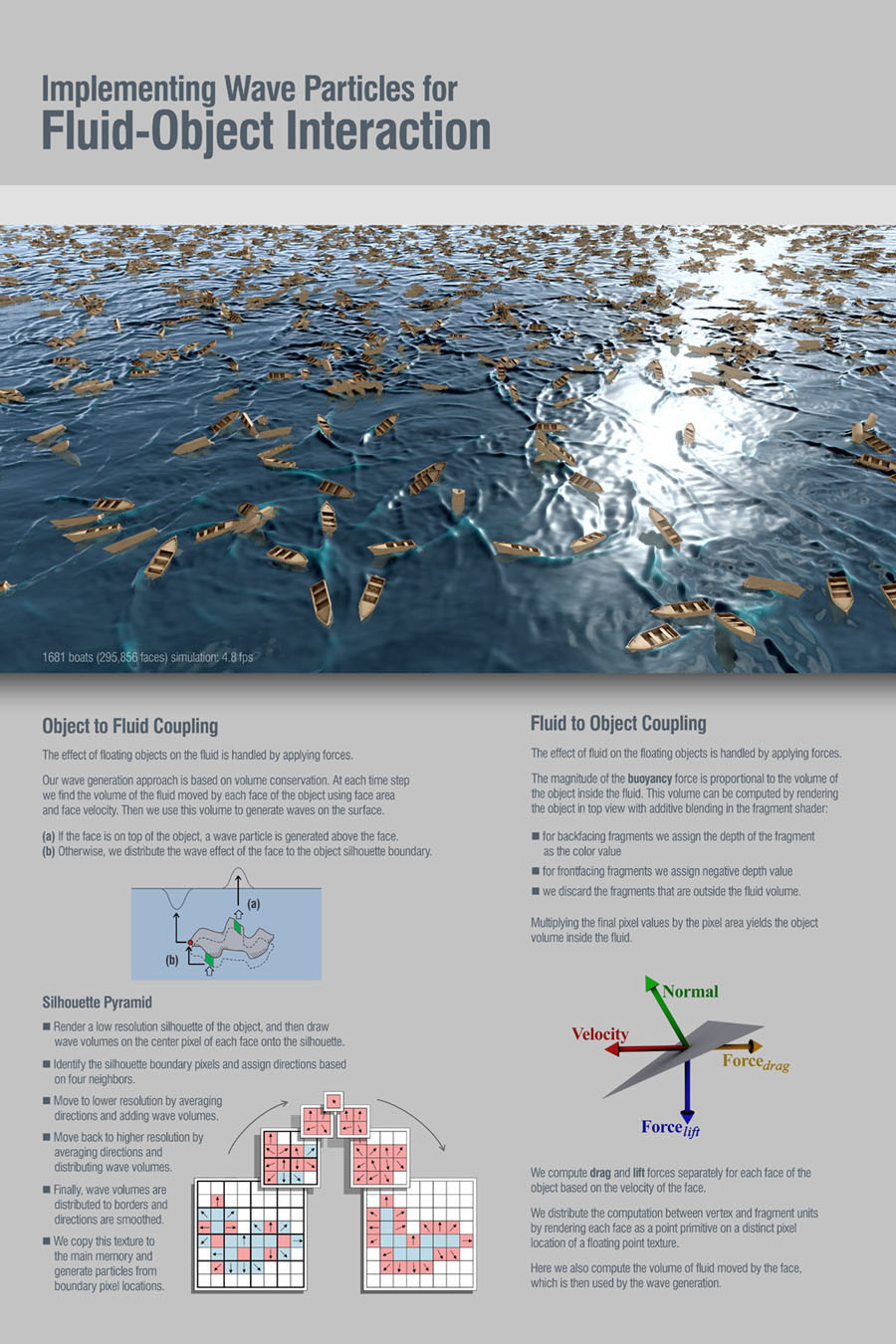
This scene has 1681 boats (295,856 faces), and the simulation runs with 4.8 fps on an NVIDIA GeForce 7900 GTX graphics card (released in 2006). Similar to the previous examples, motion of the boats is induced by fluid-object interaction forces acting on the rotating propellers and rudders. Click on the image to enlarge.
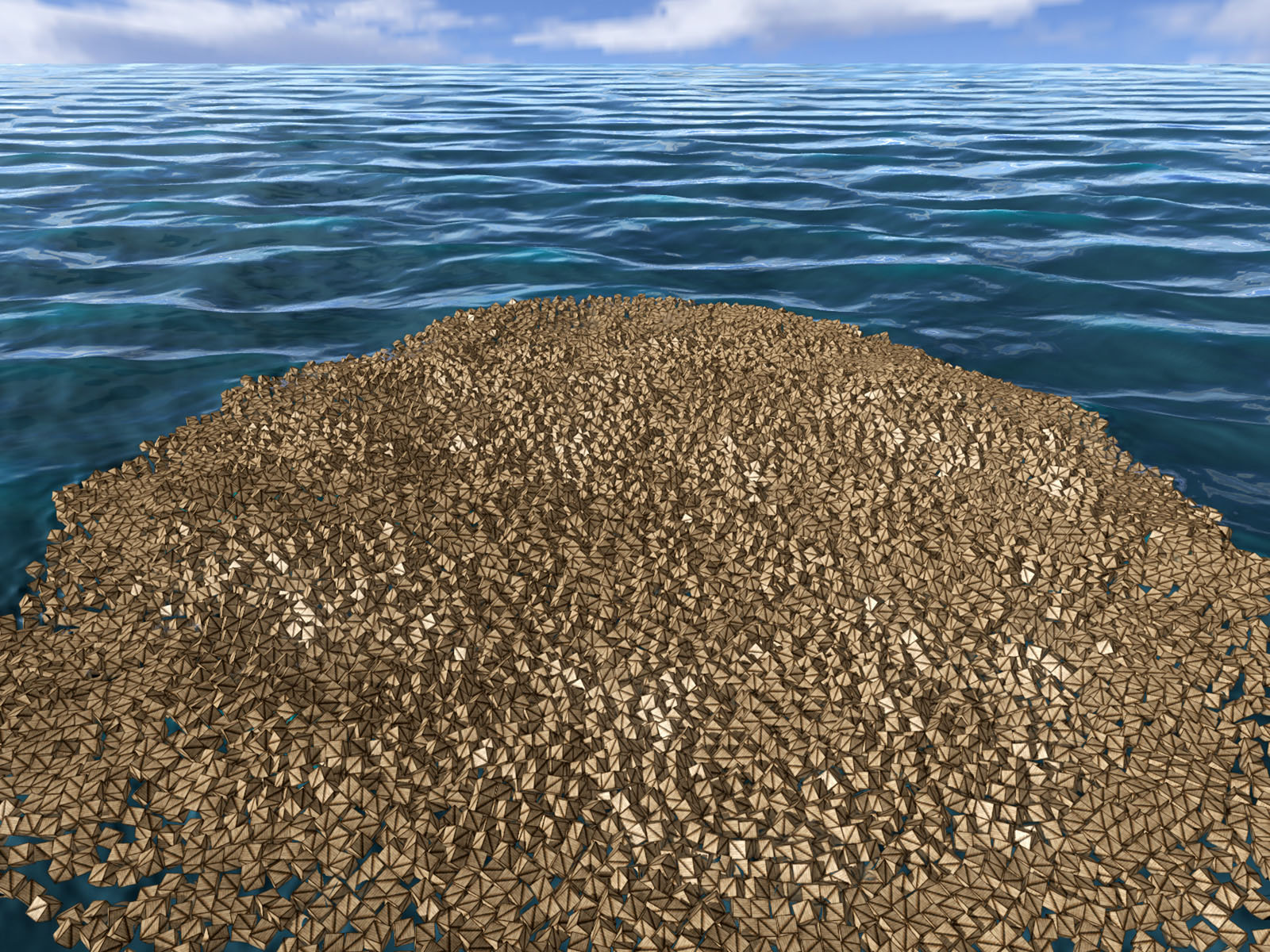
This scene has over 9261 boxes (444,528 faces), and the simulation runs about 1 fps on an NVIDIA GeForce 7900 GTX graphics card (released in 2006). The bottleneck in this scene is the rigid body simulation, not wave particle simulation or fluid-object interaction. Click on the image to enlarge.
Videos
This is the SIGGRAPH2007 Computer Animation Festival video of Wave Particles.
This is the Wave Particles paper video from SIGGRAPH2007. All timings were recorded on a computer with 2.13 GHz Intel Core 2 Duo processor and NVIDIA GeForce 7900 GTX graphics card (released in 2006).
This is one of our offline scenes with over 1600 interacting boats. The simulation runs with 4.8 fps on a GeForce 7900 GTX graphics card (released in 2006).
Publications
 Dissertation - 9.8MB
 BibTeX
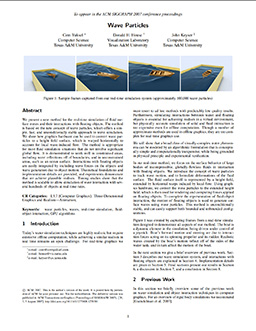 Paper (Preprint) - 1.3MB
 Publisher's Page
 Youtube VideoBibTeX© ACM, 2007. This is the author's version of the work. It is posted here by permission of ACM for your personal use. Not for redistribution. The definitive version was published in ACM Transactions on Graphics (SIGGRAPH 2007), {26, 3, 5 August 2007} http://doi.acm.org/10.1145/1275808.1276501
 Slides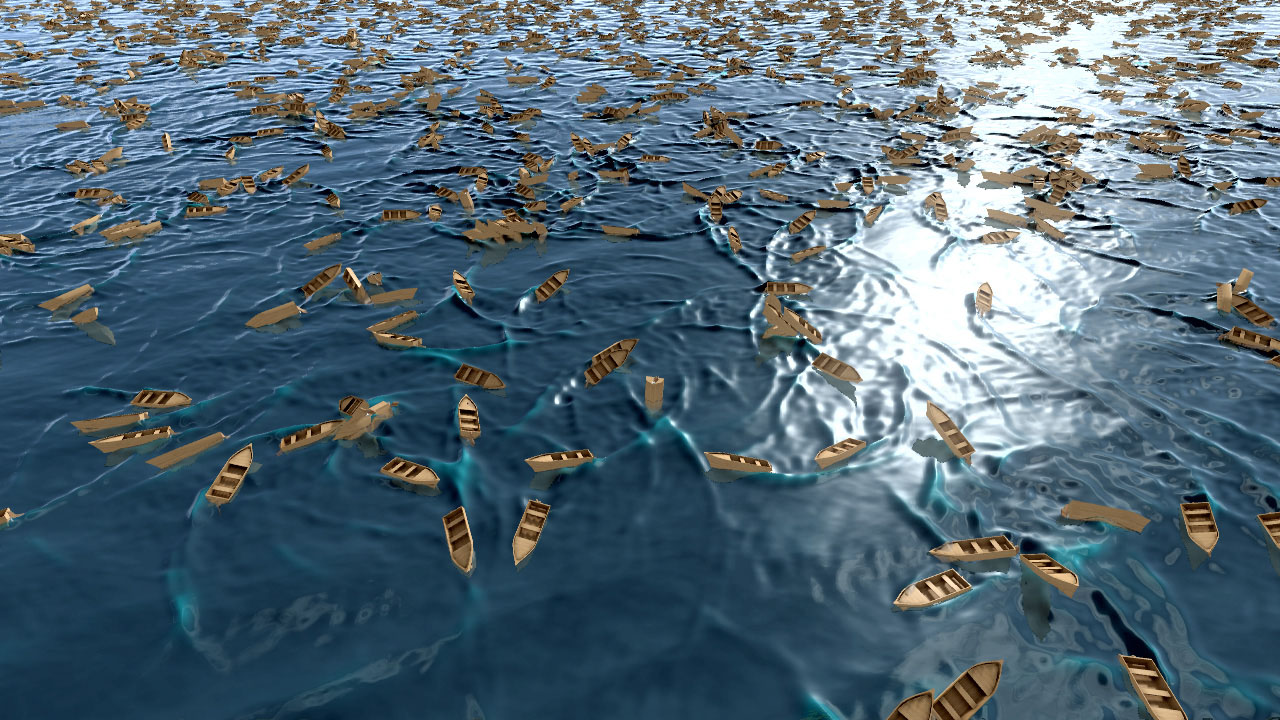
 |
 |
 |
| ACM SIGGRAPH 2007 Research Posters | ||
Additional Resources
- The details of the Silhouette Pyramid method for fast generation of wave particles are explained in detail here.